I sometimes struggle with two things - dwelling on the past a bit too much and wondering if I’m cool enough for my friends.
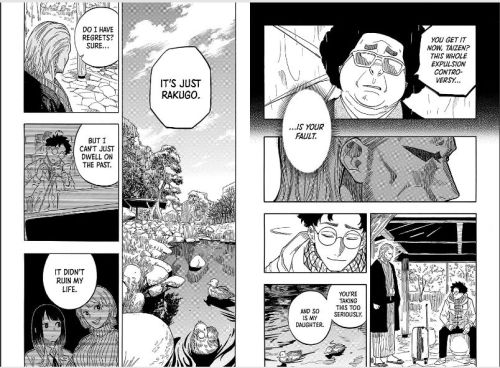
After reading the Futatsume Debut arc in Akane-banashi, I started to feel a little different about my struggles. Especially after seeing the following scenes in Chapters 96 and 97 of the manga.
ALT
ALT
ALT
ALT
ALT
The initial premise of the series involved Akane Arakawa’s father, Shinta Arakara, being expelled from the rakugo scene. He ends up being a regular salesman, but is moving forward. That’s the most important thing. It’s okay if you feel like you can’t move on from bad stuff that happened. But definitely take steps to go forward. They don’t have to be big ones as long as you do it.
Plus I feel like we tend to overvalue super-bad experiences involving other people especially if we’re on the receiving end of them. We think that life as we know it is over. But you know what, those experiences tend to help us grow and learn. They also make you more resilient than you think.
Life situations changing dramatically doesn’t mean it will turn out bad. They can go in either direction, but I like to think that we got this somehow. I’ve always felt that I couldn’t move forward from certain experiences, but here I am enjoying life for what it’s worth still.
The scene featuring Akane and her friends is relatable. I do believe that we get anxious over how we truly fit in with others in the world. We want people to like us, but we’re afraid to show our vulnerabilities. Sometimes, we are a bit much. Akane is the definition of someone who can be a bit much. I know I act like her at times. It’s okay though. Akane’s friends are telling her that she’s already enough. That’s because Akane is so comfortable in her own skin that she should just be herself during rakugo.
Sometimes, being ourselves can drive other people away. But it definitely attracts other people who will genuinely appreciate you. As I said earlier, it goes both ways. I continue to learn this as I continue to meet new people in my life.
And if you’re going to be moving forward while being more natural, definitely do it with a smile. That’s what will make you look really cool and take on life’s challenges.
Initial D - The First Stage to the Overall Magic of Anime and Manga
ALT
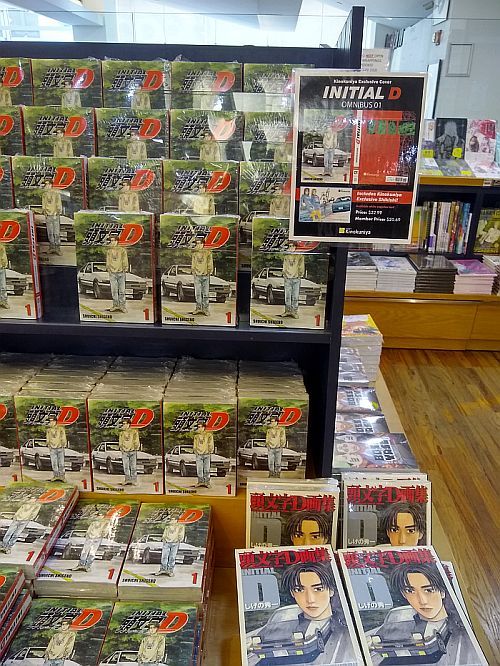
Seeing this display at my local Kinokuniya Bookstore branch made my day and got me reminiscing.
In the early 2000s’, I was still in my phase of consuming everything Dragon Ball. I followed Dragon Ball GT at the time and knew it ended around 1997. Since simulcast streaming wasn’t a thing, I had to rely on Chinese-dubbed VHS tapes to rent for all the episodes.
When watching one of the final episodes of Dragon Ball GT on a tape I got, there was a trailer (which was actually the opening) for another anime that played before the episode. It wasn’t for a Shonen Jump series and I heard some really cool-sounding techno music.
That opening began my journey into a series that highlighted what anime and manga was really like outside of American marketing - Shuichi Shigeno’s Initial D.
To Strip the Flesh - A Powerful Story About Identity
ALT
“I don’t want to die having given up. I don’t want to drown in a puddle. I don’t want to die looking like this. I want to die as a man.”
I got a chance to finally read Oto Toda’s acclaimed short story “To Strip the Flesh” on Transgender Visibility Day and it’s a wonderful story not about gender identity, but trying to find your path with the help of compassionate understanding.
The story is about Chiaki Ogawa, an transgender individual born female who identifies themselves as male. Chiaki is currently a Youtuber whose main focus is butchering wild animals that his father hunts and does livestreams of the butchering for a living. Chiaki lives with their father and is happy with his job. However, his dad has colon cancer and wants Chiaki to get married as a normal female would as Chiaki’s dead mother wanted it to be their final wish. Chiaki has always felt conflicted about his gender identity after learning about GID (gender identity disorder) during 6th grade. This tension becomes even heavier when a young Chiaki, trying to prove themselves in the wild, almost gets killed by his father in a forest when he was hunting a wild boar. The incident causes Chiaki to stop wanting to be a boy for the sake of his father as the latter blamed himself for his actions.
While I do think family is important and society has ruined the family dynamic, parents are often insecure and sometimes project their insecurities onto their children. We see Chiaki’s father stick to gender norms about what a man does and a woman does. When Chiaki wanted to learn how to hunt, his father was adamant that only men hunt and never saw his child as what he wants to be. A parent, especially a single parent, wants to protect their child and not allow them to partake in activities that can cause them harm.
It also does not help that almost all parents do not understand anything to LGBTQ+ issues. And at the same time, a LGBTQ+ child has to be mindful that they may need the support/love of parents despite any discerning attitudes. Chiaki knew too well after his ordeal, but still walked away from his dad to find happiness once he had heard enough about marriage as a bride. And even if the parents do support them, the outside world isn’t always kind.
Chiaki thankfully has one friend in the outside world, Takato. Takato helps film Chiaki’s livestreams and tries to offer any kind of emotional support to Chiaki. He even takes the time to research GID when Chiaki decides to go to Thailand for gender surgery. Takato is worried about post-surgery side effects like despair and suicidal ideation. After Chiaki comes back from Thailand to begin his full transition to being a man, he recalls an experience back in middle school where Takato was there to help him. Chiaki was distraught over having a period and Takato gave him his pants to wear to avoid embarrassment in public.
The final part of the story is when Chiaki comes back to face his father, post-surgery. Chiaki was worried about see him cry again, but his father said he’s not crying because Chiaki got what he wanted - surgery to become the man he always wanted to be. Chiaki’s father wondered why he was obsessed with Chiaki being married as the path to happiness. He even goes on to say that children shouldn’t focus on satisfying their parents. Chiaki is then granted a hunting rifle by his dad and the story ends with a confident Chiaki, who’s become a full-time hunter like his father, in the wild and streamed on YouTube saying that he’s in the market for a girlfriend before embarking on his next hunt.
When asked about the theme of To Strip the Flesh, Toda said in their own words “Don’t succumb to your parents!” Try to find your own path. While your parents have good intentions at times, their words can often be a curse in disguise. I think about the role of family in the grand scheme of things. Often, family is about being there for your own family members and relatives. However, I sometimes wonder if we’re forgetting that while direct family is important, it’s also important to have a “family” of friends of sorts. That’s what leads to stronger communities.
I feel that parents forget this because they are forced to make “schedules” and do “life hacks” that don’t involve making time in getting to know their children. Active listening isn’t on the agenda since it’s not what modern life demands. It’s also very difficult to do.
I also think a lot of mental health problems do come from parents who want their children to be outlets for their problems and/or be totally like them to prevent uncertainty. Adverse childhood experiences can involve family a great deal.
I’m glad that Chiaki has some great support in his father and Takato. Those two made a good amount of effort to try and understand where Chiaki was coming from. You don’t have to be perfect, but at least try to be there for someone if they’re a priority in your life.
It’s okay to strip the flesh of our minds because addressing our own insecurities allows us to come to terms with who we are and what we want to be. I had to do this many times over the years. The flesh figuratively and literally does protect, but sometimes we need to rip it open to see what our hearts are desperately telling us. Deep down, we’re all unique human beings that might be considered weird at times and that’s okay. We’re all trying our best to live our lives and we should be accepted for that. And as Toda’s story highlights, I hope that we can realize this together.
I am sad and emotionally wrecked right now. We lost a legend that changed everything.
Akira Toriyama, who’s famous for Dragon Ball and working on other properties like Dragon Quest, passed away at the age of 68 this March. It sucks because we’re celebrating 40 years of Dragon Ball.
Dragon Ball Z was my gateway into anime fandom when I was a 5th grader literally 30+ years ago. Way before Toonami, I watched a Cantonese-dubbed episode of DBZ at a friend’s place and became slowly hooked ever since then. Chinatown in New York City at the time was filled with Dragon Ball Z merchandise. Posters, toys, wall scrolls, video games, trading cards, etc. You name it, it was there. DBZ fandom wasn’t as mainstream back in the early-to-mid ‘90s as it is now, but there was something. Especially for me.
I also remember my first time using the internet at a public library in 1999 and one of the first sites I visited was a GeoCities fan site about DBZ. That’s how I found out about the original manga. My first manga purchase was Dragon Ball Z Volume 1 by VIZ Media in 2003 and it was a big-sized volume that was priced at $14.95 at the time.
Dragon Ball Z also got me closer to one of my younger cousins during the Toonami years and we formed a bond over anime since that time. I would play make-shift DBZ scenarios with him when he was little. I had Dragon Ball Z figures at the time. When I think about those days, I realize that it’s those moments that count especially when kids are dealing with so much competitive stressors that don’t encourage play.
I know everyone has their favorite Dragon Ball characters, but my favorite character ever is Vegeta. I wrote a whole bunch of articles about him through the years. One of my top posts ever was about growing up with Vegeta. And that was written 13 years ago.
At the time, I felt similar to Vegeta. I have this very lone wolf-ish disposition despite appearing friendly to a lot of people. I’ll admit that I have softened a lot over the years. I don’t have as much pride as Vegeta does as of late. But the thing about Vegeta lately is that he’s a much different character than in the past. If you follow the Dragon Ball Super manga, you know what I’m talking about.
And then I realize I’ve grown up alongside Vegeta for 3 decades. It’s surreal. Part of me feels like I haven’t changed all that much like he has, but I have grown up in ways that I wouldn’t have expected.
Which leads me to this - if it weren’t for Dragon Ball Z, I wouldn’t have gotten into anime. I wouldn’t have gotten to explore other series beyond it. I wouldn’t have gotten into manga. I wouldn’t have met friends in fandom in my '20s. I wouldn’t have fallen deep into the JRPG abyss. I wouldn’t have gotten into Yakuza/Like a Dragon afterwards. I wouldn’t have gotten into Japanese mahjong as a result of that. Dragon Ball Z started a chain effect that’s still sending ripples to me to this day.
Akira Toriyama provided a introduction for me and everyone looking for something different into the world of Japanese pop culture. He is Cool Japan to me. Toriyama got so many people to see how wild, imaginative, fun, and inspiring Japanese pop culture media was. It’s arguable that Toriyama had a much bigger impact on overseas fandom than Osamu Tezuka.
A lot of people involved in anime and manga would not be here if not for Toriyama. I want us to acknowledge that. I know I have. He was a game-changer or should I say, a world-changer for everything related to the perception of anime and manga globally.
Rest in peace and power, Toriyama-sensei! You will never, ever be forgotten!
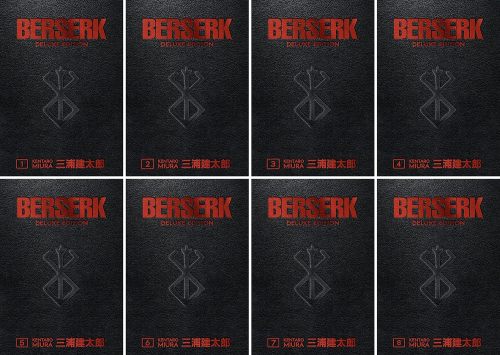
I often keep up with what’s selling in the manga world, so it’s not a surprise that I check out ICv2’s Manga Week when the site posts up interviews and insights about the industry. What caught my eye this time was Kentaro Miura’s Berserkstill being a top-seller and a top manga franchise in the English-speaking side of the world.

 ALT
ALT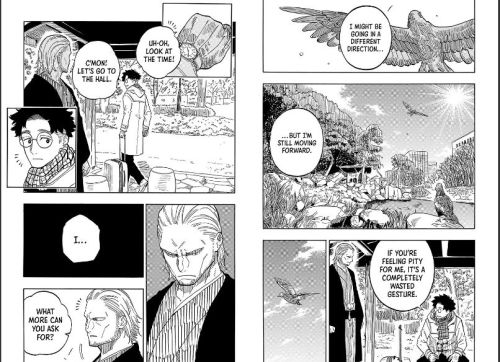 ALT
ALT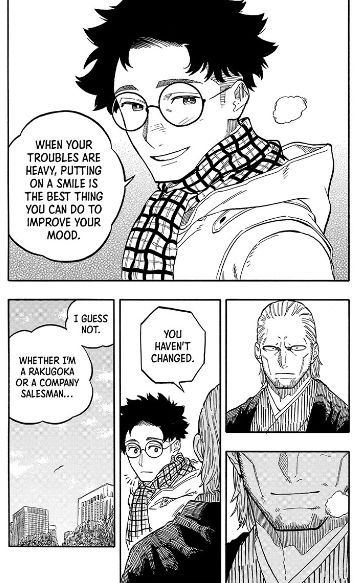 ALT
ALT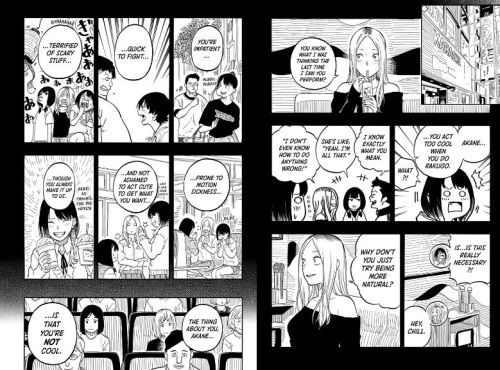 ALT
ALT ALT
ALT